Word games for seniors
How to Make an Opposite-Word Matching Game for Seniors
Make a reusable opposite-word matching game for seniors with 30 large-print cards, three play styles, contextual clues and checked answers.
Make 30 clear opposite-word cards
An antonym is a word or phrase whose meaning is the opposite of another word or phrase. For this activity, write one word on each card and match it with the card that expresses the intended contrast.
Cut 30 plain cards from index card or sturdy paper. Write one word in large dark letters on each card, using the exact list below. Keep the back blank so the printed word is the only clue.
Start with five pairs rather than putting out all 30 cards. The National Institute on Aging recommends matching an activity to what a person can do, helping the person get started and watching for frustration. Add another set only when the player wants a longer game.
Card set 1: familiar position and daily-life words
Make one card for every capitalized word. Mix these ten cards before placing them face up on the table.
- AWAKE — ASLEEP
- NEAR — FAR
- LEFT — RIGHT
- DAY — NIGHT
- FRONT — BACK
Show answers or guidance
The five intended pairs are AWAKE with ASLEEP, NEAR with FAR, LEFT with RIGHT, DAY with NIGHT, and FRONT with BACK.
Card set 2: actions and choices
These five pairs use actions. Read the matched words aloud in both directions, such as PUSH and PULL, then PULL and PUSH.
- PUSH — PULL
- ARRIVE — DEPART
- INCLUDE — EXCLUDE
- REMEMBER — FORGET
- RAISE — LOWER
Show answers or guidance
The five intended pairs are PUSH with PULL, ARRIVE with DEPART, INCLUDE with EXCLUDE, REMEMBER with FORGET, and RAISE with LOWER.
Card set 3: a little more challenge
Use this set after the familiar pairs, or select only two or three pairs from it. Each contrast appears in a checking sentence in the next section.
- VISIBLE — HIDDEN
- PUBLIC — PRIVATE
- MAXIMUM — MINIMUM
- PERMANENT — TEMPORARY
- POSSIBLE — IMPOSSIBLE
Show answers or guidance
The five intended pairs are VISIBLE with HIDDEN, PUBLIC with PRIVATE, MAXIMUM with MINIMUM, PERMANENT with TEMPORARY, and POSSIBLE with IMPOSSIBLE.
Play style 1: face-up table matching
Place five mixed pairs face up with plenty of space between cards. Choose one card, read it aloud and look for its opposite. Put the two cards side by side, then say the completed pair together.
A partner can begin with an example: choose DAY, find NIGHT and place the cards together. For the next turn, invite the player to choose any card rather than assigning a particular one.
If ten cards feel crowded, place out three possible matches for one target card. For example, show NEAR as the target and offer FAR, NIGHT and BACK. Remove unrelated cards after the answer so the table stays uncluttered.
Play style 2: spoken clues without writing
Keep the cards in a stack and read one clue at a time. The player can say the opposite, point to one of two cards or ask to hear the clue again.
Use these original clues: 'You are awake now; at bedtime you may be ___.', 'The shop is near; the airport is ___.', 'Please push the door from this side; from the other side, you would ___ it.' and 'The note was visible on the desk, but the key was ___ in the drawer.'
The intended answers are ASLEEP, FAR, PULL and HIDDEN. If another answer makes sense, explain which word the clue was designed to match rather than treating the response as a failure.
Show answers or guidance
Clue 1: ASLEEP. Clue 2: FAR. Clue 3: PULL. Clue 4: HIDDEN.
Check the harder pairs in a sentence
Some words are easier to match when a sentence establishes the intended meaning. Read each sentence and choose the card that completes the contrast.
- 1. Everyone may read the PUBLIC notice, but the personal letter is ___.
- 2. Ten is the MAXIMUM number allowed in this example; two is the ___.
- 3. The stone sign is PERMANENT, but the paper sign is ___.
- 4. Finishing today is POSSIBLE; finishing before we started would be ___.
- 5. Please INCLUDE the first page but ___ the blank page.
Show answers or guidance
1. PRIVATE. 2. MINIMUM. 3. TEMPORARY. 4. IMPOSSIBLE. 5. EXCLUDE.
Play style 3: a cooperative small-group round
Give each person one or two cards, then place the matching cards face up in the centre. Read one centre card and invite the person holding its opposite to place the pair together.
Do not eliminate players or require the fastest answer. Let the group confer, swap cards and ask for a two-choice hint. After a match, invite someone to use both words in one short sentence.
For a five-minute round, use Set 1. For a longer round, mix Set 1 with two action pairs. Save Set 3 for a group that requests more challenge.
Make the matching game easier or more challenging
To simplify, use three pairs, keep every card face up and arrange the first word from each pair in a left-hand column. Offer two possible matches and read both choices aloud.
To add challenge, turn the cards face down for a memory-style matching round, ask for a sentence using both words or mix ten cards and set a target of finding three pairs. A timer and score are optional, not required.
Stop, shorten the set or change activities when attention fades or frustration appears. The cards can be saved in three labelled envelopes so the same game is easy to restart another day.
Choose more large-print word activities
Our large-print activity-book guide explains how to compare type size, spacing, instructions and answer sections. Our memory-activity-book guide helps families and caregivers match activity style, interests, support level and setting to the reader.
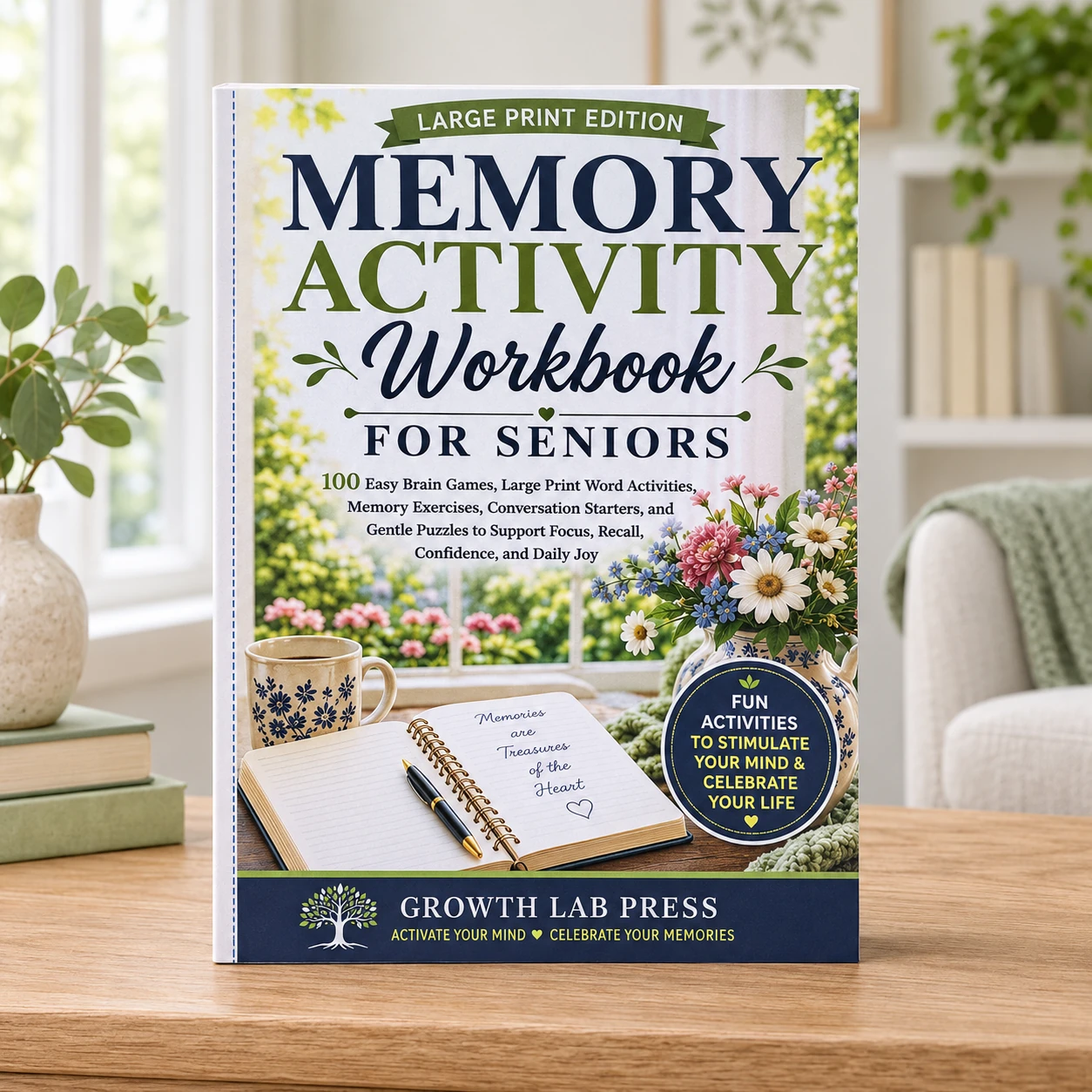
Memory Activity Workbook for Seniors by Michael Bennett is a large-print paperback with memory recall activities, word games and trivia, everyday prompts, conversation starters, reflection pages and spacious writing pages. Memory Activity Workbook for Seniors, Volume 2 contains 180 large-print word, number, matching, visual, logic, planning and maze activities in 12 chapters, with an easy-to-medium progression and complete solutions; its current product page lists paperback and hardcover formats.
Use the linked product pages to inspect the real covers, photographs and current details. The 30 cards, clues and play styles above were created for this article and are not presented as sample pages from either workbook.
Common questions
What is an easy opposite-word matching game for seniors?
Write five familiar opposite pairs on ten separate large-print cards, mix them face up and match each word with its opposite. DAY and NIGHT, NEAR and FAR, and LEFT and RIGHT make a simple first round.
Can the opposite-word game be played without writing?
Yes. Read a word or contextual clue aloud and let the player say the opposite, point to one of two cards or ask a partner to place the chosen card.
How many opposite-word cards should I use at once?
Begin with three to five pairs. Add more only when the player wants a longer or more challenging round.
Are all opposite words exact pairs in every sentence?
No. Context determines the intended contrast. A card pair can be correct for this activity even though one word may have a different opposite in another sentence.
Sources and further reading
Published by Growth Lab Press. Read our editorial standards.