Word games for seniors
15 Easy Suffix Word Puzzles for Seniors, With Answers
Try 15 easy suffix word puzzles for seniors, with clear clues, suffix banks, spelling tips, checked answers and ways to play aloud.
How to solve a suffix word puzzle
A suffix is a letter or group of letters added to the end of a word to make a new word. Cambridge Dictionary gives examples such as USE + FUL = USEFUL and STATE + MENT = STATEMENT. In these puzzles, read the base word and clue, then choose one ending from the round's suffix bank.
Use every suffix once in each round. The clue and the one-use rule make the intended set clear. For example, HELP plus the suffix -FUL makes HELPFUL, meaning ready or able to help.
These fifteen puzzles were created for this article. Cover the answer panel until the player wants to check the round, and accept a spoken answer without requiring it to be written.
Round 1: familiar endings with no spelling change
Use each suffix once. Suffix bank: -FUL, -LESS, -LY, -HOOD, -SHIP.
- 1. HELP — make a word meaning useful or ready to assist.
- 2. CARE — make a word meaning not taking enough care.
- 3. QUICK — make a word meaning in a fast way.
- 4. CHILD — make a word meaning the period when someone is a child.
- 5. FRIEND — make a word meaning the relationship between friends.
Show answers or guidance
1. HELP + FUL = HELPFUL. 2. CARE + LESS = CARELESS. 3. QUICK + LY = QUICKLY. 4. CHILD + HOOD = CHILDHOOD. 5. FRIEND + SHIP = FRIENDSHIP.
Round 2: people, actions and qualities
Use each suffix once. Suffix bank: -ER, -OR, -MENT, -IVE, -ABLE. Two answers drop a final E before the suffix is added.
- 6. TEACH — make a word for a person who teaches.
- 7. ACT — make a word for a person who performs a role.
- 8. MOVE — make a noun meaning the act or process of moving.
- 9. CREATE — make an adjective describing someone or something that uses imagination.
- 10. READ — make an adjective meaning easy or possible to read.
Show answers or guidance
6. TEACH + ER = TEACHER. 7. ACT + OR = ACTOR. 8. MOVE + MENT = MOVEMENT; the final E is dropped. 9. CREATE + IVE = CREATIVE; the final E is dropped. 10. READ + ABLE = READABLE.
Round 3: watch the spelling
Use each suffix once. Suffix bank: -NESS, -FUL, -LY, -ABLE, -OUS. Some base words change when the ending is added.
- 11. HAPPY — make a noun meaning the state of being happy.
- 12. BEAUTY — make an adjective meaning full of beauty.
- 13. EASY — make an adverb meaning without difficulty.
- 14. WASH — make an adjective meaning able to be washed.
- 15. DANGER — make an adjective meaning likely to cause harm.
Show answers or guidance
11. HAPPY + NESS = HAPPINESS; Y changes to I. 12. BEAUTY + FUL = BEAUTIFUL; Y changes to I. 13. EASY + LY = EASILY; Y changes to I. 14. WASH + ABLE = WASHABLE. 15. DANGER + OUS = DANGEROUS.
Play aloud, with cards or in large print
For spoken play, say the base word, clue and two possible suffixes. The player can answer with the finished word or only the ending. Repeat the clue, reveal the first letter of the suffix or move to the next puzzle whenever requested.
For table play, write each suffix on a separate card and print the five base words in large dark type. Put out one round at a time, pair the cards and read each finished word aloud before checking the answers.
To simplify the game, remove three suffix cards and offer only two choices for each clue. To extend it, ask for a short sentence using the completed word or invite the player to identify whether the answer names a person, thing, quality or way of doing something.
Treat spelling changes as guidance, not a test
Suffixes sometimes change the spelling of the base word. Cambridge Dictionary notes patterns such as Y changing to I in BEAUTY + FUL and a final E disappearing before some endings. The answer panels show every change used here.
If the finished word is correct but the spelling is uncertain, say the word first and check the answer together. A learner's dictionary can confirm forms that are not included in these rounds.
Different endings can sometimes make different real words from the same base. Use the clue, the round's suffix bank and the rule that every suffix is used once to identify the intended answer.
Find more large-print word activities
Our large-print activity-book guide explains how to compare text size, spacing, instructions and answer sections. Our memory-activity-book guide helps families and caregivers match activity style, interests, support level and setting to the reader.
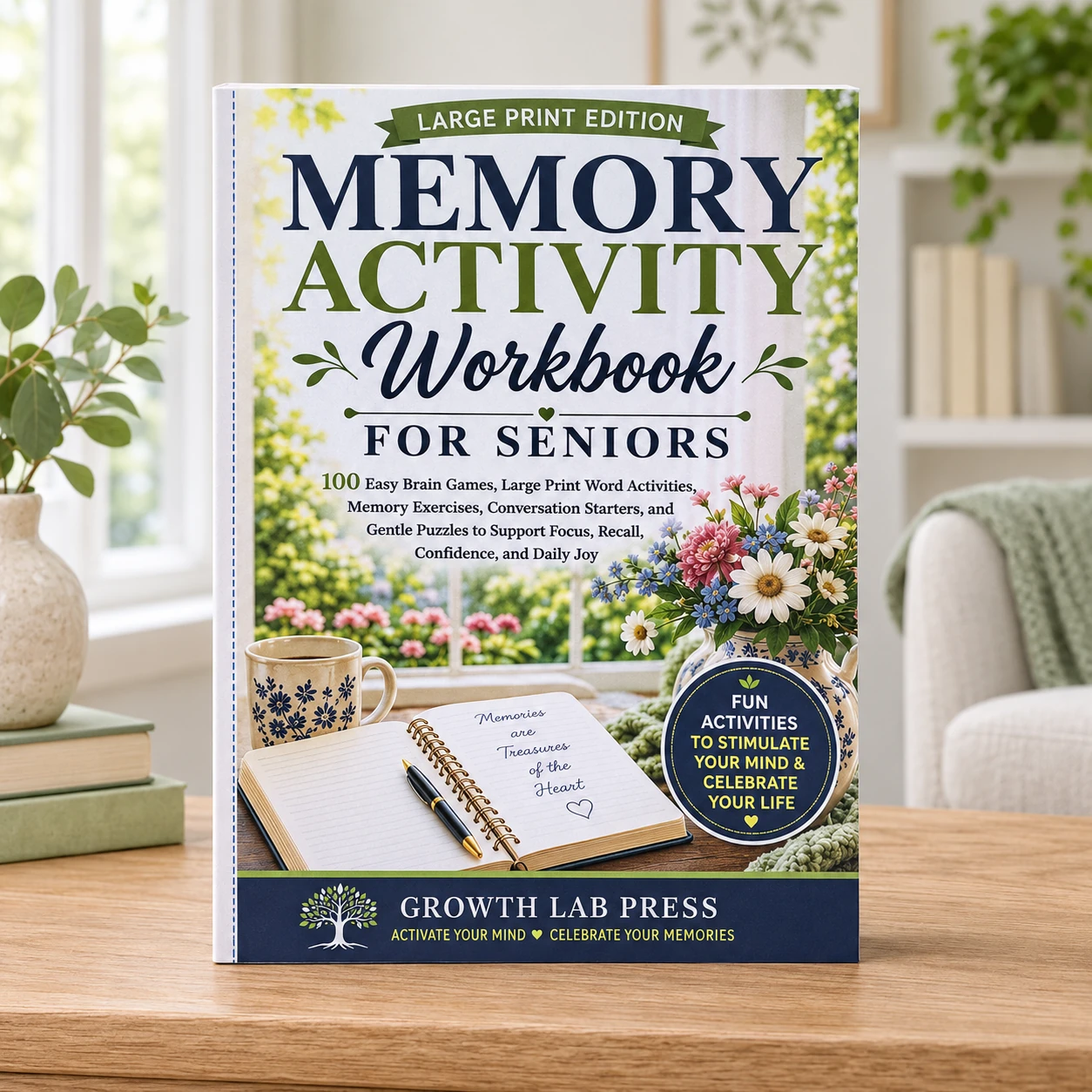
Memory Activity Workbook for Seniors by Michael Bennett is a large-print paperback with memory recall activities, word games and trivia, everyday prompts, conversation starters, reflection pages and spacious writing pages. Memory Activity Workbook for Seniors, Volume 2 contains 180 large-print word, number, matching, visual, logic, planning and maze activities in 12 chapters, with an easy-to-medium progression and complete solutions; its current product page lists paperback and hardcover formats.
Use the linked product pages to inspect the real covers, photographs and current details. The fifteen suffix puzzles above are original blog activities and are not presented as sample pages from either workbook.
Common questions
What is a suffix word puzzle?
It gives a base word, a meaning clue and possible endings. Add the suffix that creates a real word matching the clue.
Can these suffix puzzles be played without writing?
Yes. Read the base word and clue aloud, offer two suffix choices and let the player say the completed word or point to a suffix card.
Why does the spelling change in some answers?
Adding a suffix can change the base word's spelling. These rounds include examples where a final E is dropped or Y changes to I, and every change is shown in the answer panel.
Are suffixes and prefixes the same?
No. A suffix is added at the end of a base word, while a prefix is added at the beginning. The related prefix-puzzle article provides a separate set of examples.
Sources and further reading
Published by Growth Lab Press. Read our editorial standards.