Senior activities
How to Use a Deck of Cards for a 20-Minute Senior Activity
Turn one deck of playing cards into a flexible 20-minute senior activity with six simple games, clear adaptations and a ready-to-use visit plan.
Why use playing cards for a short senior activity?
Cards are familiar, portable and easy to divide into smaller sets. You can play a traditional game, but you can also sort, compare, sequence, match or use the cards as conversation prompts. That flexibility helps when a visitor wants an activity with a clear beginning and stopping point.
The National Institute on Aging lists playing cards with friends among activities older adults may enjoy and advises choosing activities that feel enjoyable rather than stressful. The Agency for Integrated Care includes playing cards as a 20-minute individual or group activity in its toolkit for seniors with higher care needs, while emphasizing that activities should be matched to the person’s interest and ability.
Ask first: ‘Would you like to play a familiar card game, try a short card activity or just watch?’ A person who enjoys bridge may prefer a known game. Someone else may enjoy sorting red and black cards for five minutes. Choice matters more than finishing every step in this guide.
Set up the cards for easier use
Use a clear table or tray with good lighting. Remove the jokers and begin with 12 to 20 cards rather than the whole deck. Large-index cards can be easier to read, and a card holder can help when holding several cards is uncomfortable.
Place one example before giving the instruction. For a red-and-black sort, put one red card and one black card into separate piles, then invite the person to place the next card. Keep instructions to one step at a time and allow time to respond.
If the activity is part of a care-home visit, follow the person’s care plan and the setting’s guidance. Stop or switch activities when the person says no, appears uncomfortable or loses interest.
Activities 1 and 2: sort and build a sequence
Activity 1 — red or black: Shuffle 12 cards and make two starter spaces. Turn over one card at a time and place it with the red suits or black suits. To simplify, use only hearts and clubs. To add choice, ask the participant to name the colour before placing the card.
Activity 2 — put one suit in order: Select the ace through ten of one suit. Mix them face up and arrange them from ace to ten, treating the ace as one. To simplify, use only ace through five. To make it more challenging, remove one card and ask which number is missing.
Example: if the row is ace, two, three, five and six, the missing card is four. This is an original blog example, not a sample page from a Growth Lab Press book.
Activities 3 and 4: find pairs and make ten
Activity 3 — matching values: Choose six pairs such as two 3s, two 5s and two 8s. Lay all 12 cards face up and group cards with the same number. Suits do not need to match. To simplify, begin with three pairs. To change the task, group all four cards of one value.
Activity 4 — make ten: Use the ace through nine, with ace counting as one. Find two cards whose values total ten. The complete pairs are ace and nine, two and eight, three and seven, four and six, plus any two 5s.
Keep the cards face up so this is a selection activity, not a memory test. If arithmetic is not enjoyable, skip it and return to colours, suits or a familiar game.
Activity 5: the higher-card round
Divide 20 number cards into two face-down piles. Each person turns over one card. The higher number takes the pair, or simply place both cards in a shared finished pile if no one wants to keep score. Treat ace as one and leave face cards out for the first round.
To simplify, use only cards from two through six. To add variety, declare that the lower card wins one round, then return to the higher card. Say the rule before each turn so no one has to remember a changing rule.
A no-score version often works well for a short visit: turn two cards, name the higher value together and move on. Stop after ten turns instead of waiting for the deck to run out.
Activity 6: use the suits as conversation prompts
Turn over one card and use its suit to choose a light conversation topic. Hearts can mean a person you appreciate; diamonds can mean an object you kept; clubs can mean a hobby or group; spades can mean a garden, outdoor place or job done by hand.
The number can set the size of the prompt, but keep it easy. A 2 of hearts might mean ‘Name two people who made you laugh.’ A 4 of diamonds might mean ‘What are four objects you remember from your childhood kitchen?’ Face cards can invite a story about a parent, teacher or community leader.
Let the participant change the suit meanings or skip any prompt. The cards are a starting point for conversation, not a demand for personal information.
A ready-to-use 20-minute card visit plan
Minutes 0–3: show the deck and offer two choices, such as sorting colours or playing a familiar game. Minutes 3–8: use 12 cards for the chosen warm-up. Minutes 8–15: try one main activity, such as matching pairs, making ten or higher-card rounds.
Minutes 15–18: turn over two conversation cards and follow whichever story interests the participant. Minutes 18–20: finish the current turn, ask which activity they would choose next time and put the cards away together if they wish.
The plan is flexible. The Agency for Integrated Care advises matching a short activity to the person’s interest and endurance. A five-minute visit that ends pleasantly can be more useful than stretching the session to fill the clock.
Add large-print activities for more variety
Our large-print activity-book guide explains how to compare readability, page spacing, instructions and subject mix. Our guide to choosing a memory activity book focuses on the person’s interests, preferred way to participate and the setting where the book will be used.
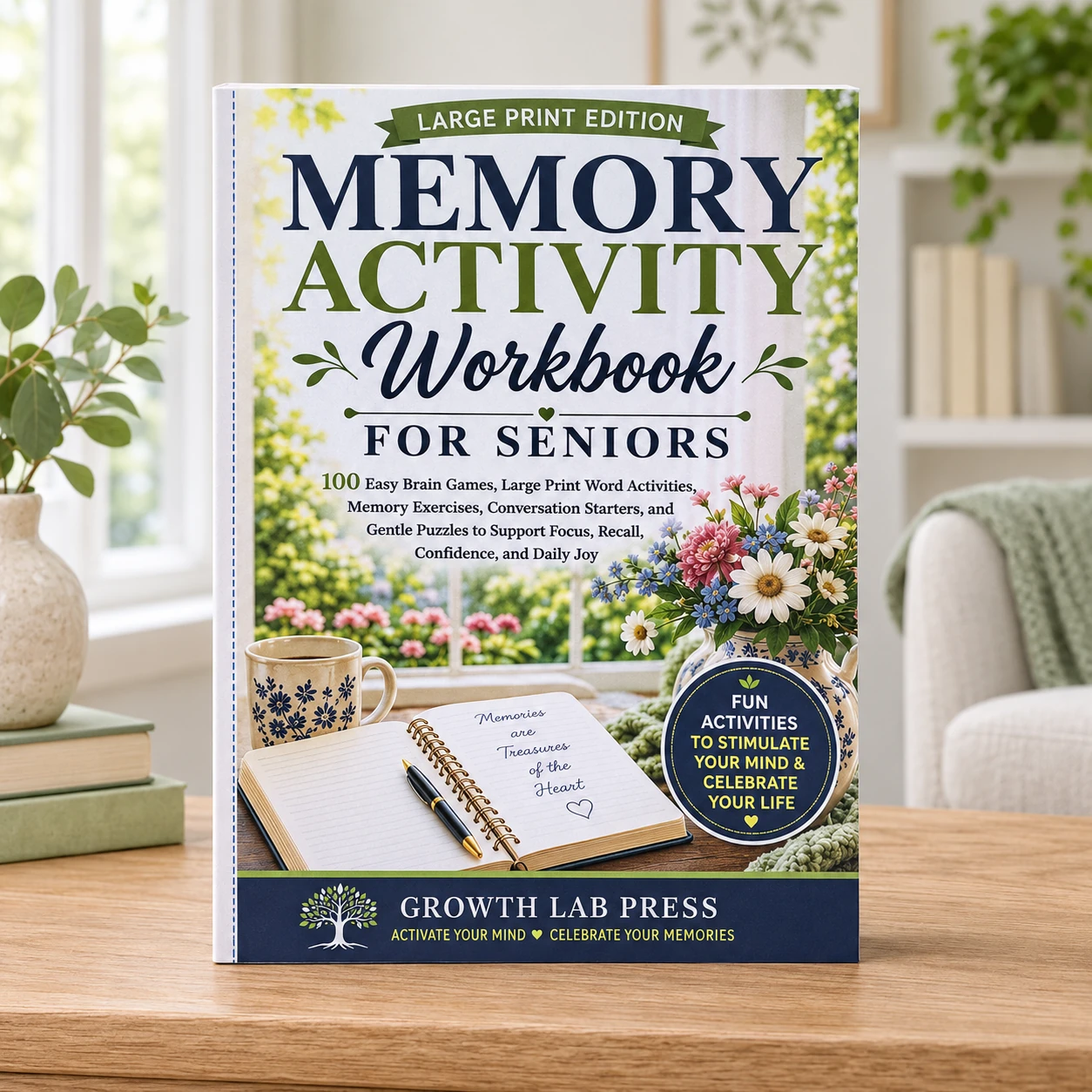
Memory Activity Workbook for Seniors by Michael Bennett is a paperback large-print activity book with memory recall exercises, word games, everyday prompts, conversation starters and reflection pages. Memory Activity Workbook for Seniors, Volume 2 includes 180 large-print word, number, matching, visual, logic, planning and maze activities across 12 chapters with complete solutions, and is currently listed in paperback and hardcover formats.
Use a workbook page or card activity as an invitation, not an assignment. Read instructions aloud, share the pencil or answer verbally when that is the person’s preference.
Common questions
What is the easiest card activity for an older adult?
Start by sorting 12 cards into red and black piles. Demonstrate one card, use one-step instructions and stop whenever the person wants.
Do we need to keep score?
No. Matching, sorting and higher-card rounds can all use a shared finished pile. Keep score only when the participant enjoys it.
How can I adapt cards for low vision?
Try large-index cards, strong lighting, fewer cards and spoken descriptions. Ask the person what helps and follow any guidance from their care team.
Can this activity be used during a care-home visit?
Yes, when the resident wants to participate and the activity fits the setting’s guidance and the person’s care plan. Bring a clean deck and keep the session flexible.
Sources and further reading
Published by Growth Lab Press. Read our editorial standards.